By Steve K.
The AA phrase the ‘Language of the Heart’ is the title of the 1988 book which published Bill Wilson’s (co-founder of Alcoholics Anonymous) Grapevine writings from the mid 1940’s –1970.
The phrase was originally used by Wilson for the title of his 1960 (July) Grapevine article which conveys the special type of communication used within Alcoholics Anonymous that facilitates a message of recovery to the alcoholic. The essay emphasizes the unique ‘power of one alcoholic talking to another’, which is characterised by a deep, shared understanding and compassion.
The sharing of lived experience, strength, and hope from a place of humility, respect, and non-judgemental acceptance is the basis of the common bond found in the fellowship of AA.
This type of communication also expresses gratitude for recovery and is a heart centred approach between members that transcends words and can be felt and seen in the meeting rooms of AA. There is a great warmth of feeling and a genuine altruism towards each other. It is ‘love and service’ in action as suggested by AA’s other co-founder, Dr Bob Smith.
When I reflect upon my early days in the fellowship of AA, I’m filled with feelings of gratitude and warmth for the men and women who accepted me and offered their support without judgement. They openly shared their experiences and feelings with a raw honesty and humility that inspired me to do the same. Through this mutual sharing I gained identification with others and some self-acceptance. I formed many authentic friendships in AA during this time and have continued to do so ever since.
I was recently asked to ‘chair’ a local AA meeting that I regularly attend and chose to share on the theme of The Language of the Heart. The meeting is a great example of this expression and heart to heart connections can be heard, seen, and felt in abundance within the group. The meeting has a real warmth and uplifting atmosphere and offers hope and belonging to the newcomer.
At the start of the meeting, I asked a friend to read an excerpt (slightly edited) from Bill Wilson’s 1960 essay ‘The Language of the Heart’, which now follows:
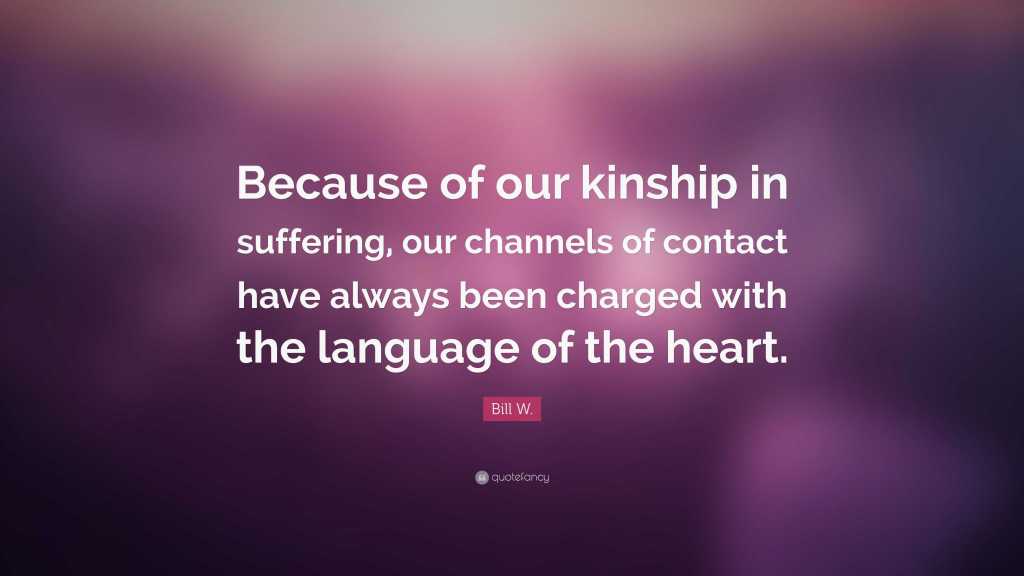
“From the beginning, communication in AA has been no ordinary transmission of helpful ideas and attitudes. It has been unusual and sometimes unique. Because of our kinship in suffering, and because our common means of deliverance are effective for ourselves only when constantly carried to others, our channels of contact have always been charged with the language of the heart. And what is that? Let’s see if I can communicate to you something of what it means to me.
At once, I think of my own doctor, William Duncan Silkworth, and how he ministered to me with the language of the heart during the last shattering years of my alcoholism. Love was his magic, and with it he accomplished this wonder: He conveyed to the foggy mind of the drunk that here was a human being who understood, and who cared without limit. He was one who would gladly walk the extra mile with us, and if necessary (as it often was), even the last mile of all. At that time, he had already tried to help over twenty thousand drunks, and he had failed with nearly all. Only here and there had this dismal experience of futility been brightened by a genuine recovery. People wondered how he could go on, how he could still believe in the possibility of help for chronic alcoholics. Yet he did believe with a faith that never faltered. He kept saying, “Someday we’ll find the answer”.
He had developed some ideas of his own about what ailed alcoholics: They had an obsession to drink, a veritable and a destructive lunacy. Observing that their bodies could no longer tolerate alcohol, he spoke of this in terms of an allergy. Their mental obsession made them drink, and their physical allergy was the guarantee that they would go mad or die if they kept it up. Here, in contemporary terms, was the age-old dilemma of the alcoholic. Total abstinence, he knew, was the only solution. But how to attain that? If only he could understand them more and identify with them better, then his educational message could perhaps reach into those strange caverns of the mind where the blind compulsion to drink was entrenched.
So, the little doctor who loved drunks worked on, always in hope that the very next case might somehow reveal more of the answer. When I came to him, his more recent ideas and tactics had begun to produce slightly improved results. So, encouraged, his efforts to treat me were characteristic of the enthusiasm and hope of a young doctor on his first critical case. He told me what a hellish malady alcoholism is, and why. He made no promises, and he did not try to conceal the poor recovery rate. For the first time, I saw and felt the full gravity of my problem. I learned, also for the first time, that I was a sick man emotionally and physically. As every AA today knows, this knowledge can be an enormous relief. I no longer needed to consider myself essentially a fool or a weakling.
This new insight, plus the little doctor’s account of a few of his good recoveries, brought me a surge of hope. But above all, my confidence rested on the understanding, the interest, and the affection he so freely gave me. I was not alone anymore with my problem. He and I could work it through. Despite several discouraging slips, I truly believed this for quite a while. And so did he.
But the hour finally arrived when he knew that I was not going to be one of his exceptions. He would have to begin to walk that last mile with my wife Lois and me. Characteristically, he found the courage gently but frankly to tell us the whole truth: Neither mine nor his nor any other resources he knew could stop my drinking; I would have to be locked up or suffer brain damage or death within perhaps a year.
It was a verdict I would not have accepted from any other person. He had spoken to me in the language of the heart, and so I was able to receive the truth he offered me. But it was a terrible and hopeless truth. He spoke in the name of science, which I deeply respected, and by science I seemed condemned. Who else could have driven home this indispensable principle on which every recovery depends? I seriously doubt that any other man could have done it.
Today, every AA member implants in the newcomer just what Dr. Silkworth so powerfully lodged in me. We know that the newcomer has to hit bottom; otherwise, not much can happen. Because we are “drunks who understand,” we can use our own experience of the-obsession-plus-the-allergy as a tool of such power that it can shatter the newcomer’s ego at depth. Only thus can he be convinced that on his own unaided resources he has little or no chance.
I was in precisely this state of inner collapse when, in November of 1934, I was visited by Ebby. He was an old friend, an alcoholic, and my sponsor-to-be. Why was it that he could communicate with me in areas that not even Dr. Silkworth could touch?
Well, first of all, I already knew that he himself was a hopeless case—just like me. Earlier that year, I had heard that he, too, was a candidate for the lockup ward. Yet here he was, sober and free. And his powers of communication now were such that he could convince me in minutes that he really felt he had been released from his drinking compulsion. He represented something very different from a mere jittery ride on the water-wagon. And so, he brought me a kind of communication and evidence that even Dr. Silkworth could not give. Here was one drunk talking to another. Here was hope indeed.
Ebby told me his story, carefully detailing his drinking experiences of recent years. Thus, he drew me still closer to him. I knew beyond doubt that he had lived in that strange and hopeless world where I still was. This established his identification with me. At length, our channel of communication was wide open, and I was then ready for his message.”
Bill Wilson.

 12-STEP PHILOSOPHY