By Steve K.
In the chapter ‘We Agnostics’ in the book ‘Alcoholics Anonymous’, it says: “That means we have written a book which we believe to be spiritual as well as moral.” The 12 Steps of AA are suggested as a spiritual and moral solution to the problem of alcoholism. AA views addiction as a problem of the mind, body, and soul— ‘a three-fold illness’. This spiritual perspective and solution acknowledge the existential reality of human moral imperfection, that has been described historically by philosophers, theologians, political thinkers, and more recently by modern psychologists (e.g., Jonathan Haidt’s book ‘The Righteous Mind’).
Modern psychology, in its own way, has arrived at a perspective remarkably consistent with this view of human moral imperfection. Rather than viewing human beings as fully rational, self-transparent, and easily perfected, contemporary psychological research highlights our limited rationality, cognitive biases, vulnerability to self-deception, emotional reactivity, relational wounds, and evolutionary ‘design flaws’ that make us anything but morally or psychologically perfect.
Purely secular approaches to the treatment of addiction, such as SMART Recovery or CBT, focus on behaviour, thought patterns, and relapse prevention. While this focus is effective, it largely neglects the moral and spiritual dimensions of human life—the recognition of our limitations, fallibility, and the need for humility and connection to something greater than ourselves. From the perspective of the “crooked timber” tradition, this omission bypasses an existential reality: that recovery is not only about managing impulses or correcting thinking, but also about confronting (self-confrontation) human imperfection, moral weaknesses and conflict, and engaging in a process of personal transformation and growth. AA articulates this moral realism through what historian Ernest Kurtz described as the “spirituality of imperfection.”
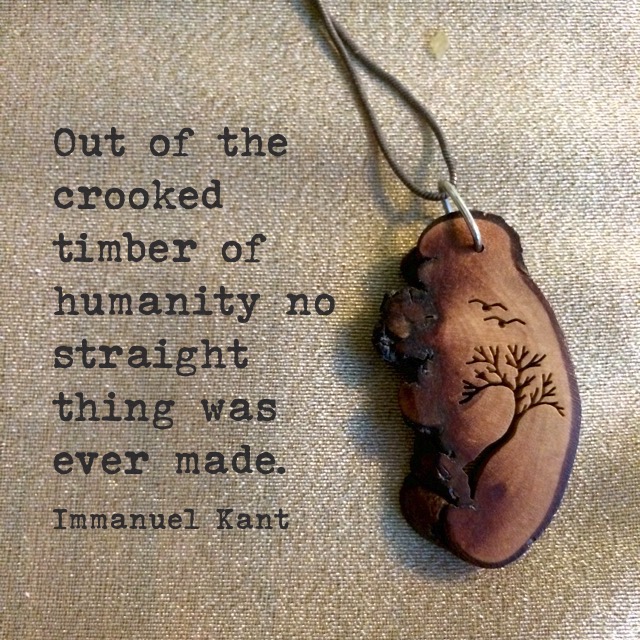
Immanuel Kant famously wrote:
“Out of the crooked timber of humanity, no straight thing was ever made.”
With this sentence, Kant named something profound about human nature—we are inherently incapable of moral perfection. We are limited, morally conflicted, and prone to self-deception and rationalisation. This is not accidental, but fundamental to our evolution and structural make up. Human goodness is also fundamental to our nature, but it coexists with imperfection rather than transcends it.
The political philosopher Isaiah Berlin developed Kant’s metaphor perceiving human values as tragically conflicted (e.g., freedom vs equality). Human ethical values often compete and clash with each other making moral purity and societal utopia impossible. Attempts to impose moral harmony are contrary to our inherent moral pluralism and inevitably result in suffering and oppression. Instead, wisdom lies in humility, compromise, realism, and compassion for human limitation.
The theologian Reinhold Niebuhr (author of the ‘serenity prayer’) expressed this insight in his Christian Realism—arguing that human beings are marked by a deep moral tension: we are capable of reason, love, and moral vision, but also profoundly anxious, insecure, self-protective, and proud. Niebuhr interpreted the Christian doctrine of “original sin” not as a literal historical event, but as a mythic truth about the human condition. Niebuhr’s realism suggests that moral and personal maturity begin with honest and humble acknowledgement of our human flaws.
Ernest Kurtz recognised that Alcoholics Anonymous follows this “crooked timber” intellectual and spiritual lineage. In his book, ‘The Spirituality of Imperfection’, Kurtz argues that AA does not present a spirituality of achievement, perfection, or mastery. Instead, it embraces a spirituality acknowledging limitation, that tells the truth about oneself, that accepts human ‘crookedness’—finding meaning within it rather than trying to deny it. AA spirituality admits that the self cannot perfect itself, control everything, or escape its vulnerabilities.
Bill Wilson and the AA View of the Human Nature
Bill Wilson’s writing (and AA tradition as a whole) expresses this crooked-timber realism in psychologically concrete terms. The alcoholic is not portrayed as a monster on one extreme nor a victim without agency on the other, but as a human being whose best intentions repeatedly fail under self-will, pride, fear, and self-deception.
Bill W suggests that the alcoholic mind:
- overestimates its own power.
- rationalises destructive behaviour.
- exaggerates autonomy while denying dependence.
- cycles between grandiosity and despair.
AA’s first step— “admitted we were powerless”—is therefore not humiliation; it is existential honesty, an entry into the same tradition Berlin, Niebuhr, and Kurtz describe. It is the confession that the self is not the god of its own life. Where rigid moralism demands impossible purity, AA strives for ‘progress not perfection’ and invites humility, connection, accountability, and grace.
Where AA Stands in the Crooked Timber Tradition
Put simply, AA takes Kant’s crooked timber metaphor, Berlin’s tragic moral pluralism, Niebuhr’s moral realism, and Kurtz’s spirituality of imperfection, and embodies them in lived practice. AA assumes:
- human beings are not perfectible.
- moral growth comes from honest confession and willingness to change.
- humility is strength, not weakness.
- community is essential because we need each other.
- spirituality begins not with superiority, but with unity in shared human limitation.
AA does not deny the human capacity for goodness; it locates goodness precisely within the acceptance of imperfection. Recovery is not about becoming morally flawless; it is about becoming honest, grounded, humble, relational, and real.
In that sense, AA is one of the clearest modern expressions of the crooked timber tradition. It affirms what Kant glimpsed, Berlin articulated, Niebuhr theologised, and Kurtz named: that our crookedness is not the end of the story. It is the condition under which all real spiritual growth takes place.
AA’s spiritual and moral solution addresses the nature of being human and an alcoholic. In the chapter ‘Acceptance was the Answer’ in the book Alcoholics Anonymous, p 416, 4th edition, it says:
“It helped me a great deal to become convinced that alcoholism was a disease, not a moral issue; that I had been drinking as a result of a compulsion, even though I had not been aware of the compulsion at the time; and that sobriety was not a matter of willpower.”
This is an important expression of AA’s non-moralistic attitude towards alcoholism despite the Big Book’s use of 1930’s moral language to describe the spiritual malady (selfishness, self-centred fear etc) resulting from and perpetuating alcoholism. Alcoholics Anonymous is not saying that alcoholism is a result of a moral failure of character but rather a consequence of a pathological physical and psychological craving and compulsion. A craving and compulsion that causes moral and relational damage. A spiritual and moral approach to recovery is an appropriate treatment for alcoholics who have the same crooked nature as all human beings, as well as a compulsive illness that has spiritual and moral consequences.
Related Reading:
‘The Spirituality of Imperfection: Storytelling and the Search for Meaning‘ by Ernest Kurtz and Katherine Ketcham.
‘The Road to Character‘ by David Brooks.
‘The Crooked Timber Of Humanity: Chapters in the History of Ideas‘ by Isaiah Berlin.
 12-STEP PHILOSOPHY