By Steve K.
It’s often said in meetings of Alcoholics Anonymous (AA) that “you are not judged in the rooms of AA.” This statement is generally offered as a reassurance – to newcomers in particular — as an invitation to be honest, open, and vulnerable without fear of condemnation. However, at a recent meeting I attended, someone challenged this idea – suggesting that judgement does exist in the ‘rooms’ of AA. The comment stuck with me. It raised the question: Is AA really a judgement-free zone?
What Is Meant by “Not Judged”?
It would be wrong to suggest that the phrase is meant as a literal description of how every AA member behaves at all times. Rather, it reflects the spirit of AA — an ethos of acceptance, understanding, and mutual support grounded in shared suffering and shared hope. Most people walking through the doors of an AA meeting will have a story of struggle relating to alcohol. Often that story includes shame, regret, and moral failure. And because most of us in the rooms of AA have been there, there’s a general absence of moral condemnation in relation to alcoholic drinking and the associated behaviours that accompany it.
As the Big Book says:
“We are people who normally would not mix. But there exists among us a fellowship, a friendliness, and an understanding which is indescribably wonderful.” (Alcoholics Anonymous, p. 17)
That “understanding” includes a powerful principle: we don’t shame people for being alcoholics. Instead, we try to meet each other where we are, offering identification rather than evaluation.
Judging vs. Being Judgemental
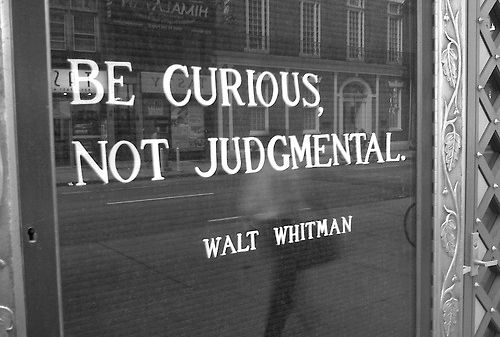
That said, I think it’s important to distinguish between making judgements and being ‘judgemental’. The former is a natural and necessary part of being human; the latter is ego based and implies an attitude of superiority, moralism, and a lack of empathy and compassion.
In any group of people — even one devoted to altruism and spiritual growth — there will be personalities who are more prone to gossip, intolerance, or black-and-white thinking. Clearly AA members are not saints:
“We are not saints. The point is, that we are willing to grow along spiritual lines.” (Alcoholics Anonymous, p. 60)
So, while AA encourages non-judgmentalism, the individuals who comprise the Fellowship of AA are imperfect. Some may fall short. Others might unconsciously come across as critical or judgemental. These human failings don’t mean the principle is false — only that we sometimes fail to practice it.
No Judgement Around Alcoholism — But What About Other Kinds of Behaviour?
It’s also worth noting that while people’s alcoholism and drinking histories are rarely judged in a harsh way in the Fellowship, other kinds of behaviour might be — particularly if they’re viewed as dishonest, harmful to others, or disruptive to the group. Sometimes this judgement comes from genuine concern; other times, unfortunately, it may come from ego or resentment.
Still, judgement about current behaviour is not always inappropriate, as we can reasonably be expected to change in recovery with time. Sponsorship, for example, involves a certain amount of guidance and encourages personal accountability. But that guidance hopefully comes from a place of love, humility, and experience — not from a sense of superiority or judgmentalism.
Projecting Low Self-Esteem
Low self-esteem is very common in the rooms of AA. It’s both a contributing causal factor of addiction and a damaging consequence of it. Building a healthy and balanced sense of self is an important aspect of recovery. Early in the recovery process – or even after some time around the rooms of AA – it’s not uncommon for us to project our internalised poor self-concept onto other people in the Fellowship.
We can often feel negatively judged due to our own sense of toxic shame and insecurity. I think the psychologist Abraham Maslow once said (I’m paraphrasing) that ‘insecurity is the birthplace of paranoia’. We can assume negative judgement where none exists – particularly if we’re still struggling with addiction or have experienced relapse. This has been my experience – my own sense of shame and insecurity has led to defensiveness and ironically being critical of others and the Fellowship in the past. Over time, I have developed some healthy self-esteem and nowadays am less judgemental towards myself and others. However, developing a healthy self-concept for many in the ‘rooms’ is a long-term project – it certainly is for me.
A Final Word
The principle of non-judgement in AA is essential because it fosters honesty — the very foundation of recovery. If people feel they must wear masks or hide parts of their story, AA meetings lose their transformative power. Honesty flourishes in a space where people feel safe, seen, and respected — not morally judged.
So, is it true to say that “you are not judged in the rooms of AA”? I would say this:
In spirit, yes — particularly regarding what brings us into the rooms of AA, which is our problem drinking.
In practice, not always — because AA is made up of imperfect people with varying degrees of self-awareness, personal ‘baggage’, and prejudice. As an ideal we aspire to, ‘non-judgement’ remains vital — because judgmentalism is the enemy of honesty and connection – and therefore, recovery.
Ultimately, the statement that “you are not judged” in the rooms of AA, functions less as a guarantee and more as an invitation: Come as you are. Be honest. We’ll try to meet you with understanding and compassion, not judgement. And if we fall short, remember ‘we are not saints’— ‘we claim spiritual progress rather than spiritual perfection.’ (Alcoholics Anonymous, p. 60)
 12-STEP PHILOSOPHY